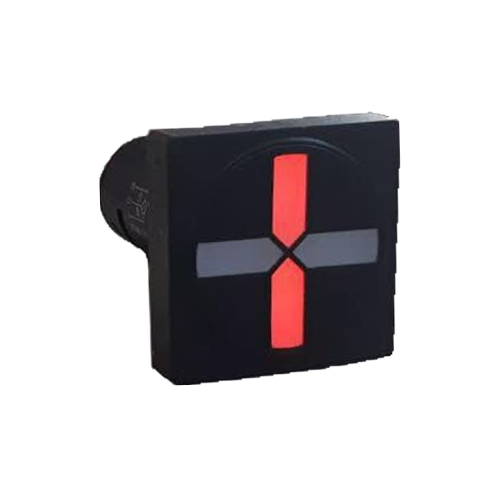
What Is a Position Indicator?
A Position Indicator, also known as a Semaphore Indicator, is an electrical or electromechanical device used to visually display the status of equipment in power systems, especially in switchgear panels, substations, and power plants. The primary function of this component is to provide quick, clear, and reliable information to the operator about the state of switching equipment such as Circuit Breakers, Disconnectors, and Earth Switches.
These indicators are typically mounted on Mimic Diagrams on the front of control panels, allowing operators to understand the overall status of the network or substation at a glance. This significantly enhances safety, reduces troubleshooting time, and helps prevent operational errors.
Types of Position Indicators (Semaphores)
Semaphores are divided into three main categories based on their structure and operating technology:
### Mechanical Semaphore
This is the oldest generation of semaphores, and its operation is based entirely on mechanical linkages and levers. A direct physical connection exists between the main equipment (like a breaker) and the indicator, so as the equipment moves, the indicator's status changes mechanically. Due to high wear and tear, slow speed, maintenance needs, and installation limitations, this type is rarely used in new designs today.
### Electromechanical Semaphore
This model is a step up from the mechanical type and uses one or more solenoids to change the indicator's status. When an electrical signal is sent from the equipment's auxiliary contacts, the solenoid is energized and moves a physical flag or indicator to display the new state (e.g., red or green). This type still has moving parts and may wear out over time, but it is faster and more flexible than the purely mechanical version.
### LED Semaphore
The most modern and common type of semaphore is the LED-based model. These indicators have no moving parts and use light-emitting diodes (LEDs) of different colors (typically red and green) to show the status. Electrical signals from the auxiliary contacts activate the semaphore's internal electronic circuits, which then light up the corresponding LED.
Key advantages of LED semaphores include:
- **Extremely long lifespan:** Due to the absence of moving parts and the long life of LEDs.
- **Very low power consumption:** Typically in the range of a few milliamperes.
- **High reliability:** Resistant to vibrations and mechanical shocks.
- **Instantaneous response speed:** With no mechanical delay.
- **Ability to display multiple states:** Such as "Traveling" or "Invalid" states.
How It Works and Connection
Regardless of the type, the operating principle of semaphores relies on the auxiliary contacts of the main equipment. For example, a circuit breaker has auxiliary contacts standardized by ANSI as `52a` and `52b`:
- **52a Contact:** A normally open (NO) contact that closes when the breaker is in the "Close" position.
- **52b Contact:** A normally closed (NC) contact that is closed when the breaker is in the "Open" position and opens when the breaker is closed.
The LED semaphore is connected to these two contacts. As the breaker changes state, one contact opens and the other closes, directing the flow of electricity to the corresponding LED (red for Close, green for Open).
Applications of Semaphores in Power Systems
### Displaying Circuit Breaker Status
This is the primary application of a semaphore. The color red conventionally indicates a "Closed/On" status, meaning current is flowing, while green signifies an "Open/Off" status, meaning the circuit is interrupted. Some advanced LED semaphores can also indicate intermediate states (e.g., during breaker operation) or invalid states (when both input signals are active or inactive) with a special indication (like both LEDs being off).
### Displaying Disconnector and Earth Switch Status
Correctly displaying the status of disconnectors and earth switches is critically important for the safety of maintenance personnel. An operator must be completely certain that a section of the network is fully isolated and earthed. Semaphores provide this visual assurance on the control panel and are often part of the electrical interlock system.
### Use in Mimic Diagrams
A Mimic Diagram, or Mimic Bus, is a schematic map of the substation or power network drawn on the control panel. Semaphores are installed at the exact locations of their corresponding equipment (breakers, disconnectors) on this diagram. This combination allows operators to quickly and visually understand the current topology of the network and make correct operational decisions.
Comparison Table of Semaphore Types
| Feature | Mechanical Semaphore | Electromechanical Semaphore | LED Semaphore |
|---|---|---|---|
| Structure | Fully mechanical, with levers and physical links | Has solenoids and moving parts | Fully electronic (Solid-State) |
| Operating Speed | Very slow | Medium | Instantaneous |
| Lifespan | Short | Medium | Very Long (>100,000 hours) |
| Power Consumption | Zero (at steady state) | High (during state change) | Very Low (a few mA) |
| Reliability | Low | Medium | Very High |
| Maintenance | High | Medium | Almost None |
| Readability | Poor, especially from a distance | Medium | Excellent, with clear and bright light |
Semaphore Selection Tips
- **Supply Voltage:** Must be compatible with the panel's DC control voltage (e.g., 110V, 48V, or 24V DC).
- **Type and Technology:** For new projects and retrofits, the LED semaphore is the standard choice due to its numerous advantages.
- **Dimensions and Appearance:** Should match the panel design and available space (square, round).
- **Mounting Cutout Standard:** Usually follows common standards like 22 mm diameter for easy installation.
Frequently Asked Questions
### What do the red and green colors mean in a semaphore?
According to industry standards, red usually means "Closed," "On," or "Active," indicating that current is flowing and a hazard exists. Green means "Open," "Off," or "Safe," indicating that the circuit is interrupted.
### What is the difference between a semaphore and a simple signal lamp?
A signal lamp typically indicates a single condition (e.g., power on, or a fault has occurred). A semaphore, however, is specifically designed to show two or more opposing states of a single piece of equipment (like open/closed) and its input logic is designed accordingly. LED semaphores can even detect and display invalid states.
### Can an LED semaphore fail?
Yes, any electronic device can potentially fail, but LED semaphores have extremely high reliability due to their solid-state design and lack of moving parts. The most common reasons for malfunction are wiring issues, auxiliary contact failure, or (rarely) the LED itself burning out after many years of service.
Rizmooj Electric Toos Position Indicators (Semaphores)
Rizmooj Electric Toos, as a manufacturer of monitoring and status indication equipment, offers a wide range of modern LED semaphores for various applications in industrial electrical panels, substations, and power plants. These products, such as the square model EPS-501LE and the round model EPC-501LE, provide a reliable and efficient solution for equipment status indication with a nominal operating voltage of 110 VDC, very low current consumption (less than 3 mA), and a long lifespan. The standard design of these products facilitates easy installation and replacement in various panels. To see all models, please visit the Position Indicator (Semaphore) products page.
Related Articles
- Difference Between LED Semaphore and Signal Lamp
- How Does a Semaphore Display Breaker Status?
- How to Wire an LED Semaphore
- Application of Semaphore in Disconnectors and Earth Switches
- Difference Between LED, Mechanical, and Electromechanical Semaphores