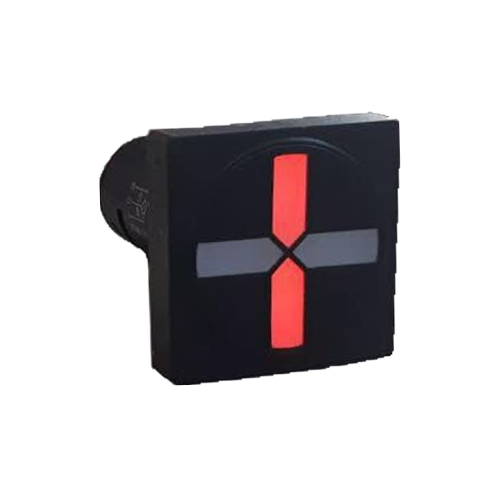
How Does a Semaphore Show Circuit Breaker Status?
Understanding the real-time status of switchgear, such as circuit breakers, is essential for the safe and stable operation of power systems. A semaphore or position indicator is a simple yet vital visual tool that provides this information clearly to operators. This article explains in detail how a semaphore detects and displays a circuit breaker's status.
### Breaker Status Detection Mechanism
A semaphore is not directly connected to the internal mechanism of a breaker. Instead, it receives its status information through auxiliary contacts. These contacts are small electrical switches that are mechanically coupled with the main opening and closing mechanism of the breaker.
- **Breaker Position:** The primary state of a breaker can be "Closed" or "Open." In the closed state, current flows through it, and in the open state, the circuit is interrupted.
- **Auxiliary Contact:** To report these states to external equipment like semaphores, PLCs, or SCADA systems, auxiliary contacts are used.
- **52a Contact:** This is a "Normally Open" (NO) auxiliary contact. This contact is open when the breaker is in the "Open" position and closes when the breaker "Closes."
- **52b Contact:** This is a "Normally Closed" (NC) auxiliary contact. It operates opposite to the 52a contact; it is closed when the breaker is "Open" and opens when the breaker "Closes."
### Status Display Logic
A standard LED semaphore has two main signal inputs (in addition to power) that connect to these auxiliary contacts. The display logic is as follows:
- **Closed Status:** When the breaker is closed, the 52a contact closes, and the 52b contact opens. The closing of 52a applies voltage to the semaphore's "Closed" input, causing it to display a **Red** light, which symbolizes a live circuit and a hazardous condition.
- **Open Status:** When the breaker is tripped or opened, the 52a contact opens, and the 52b contact closes. The closing of 52b applies voltage to the semaphore's "Open" input, causing it to display a **Green** light, symbolizing a de-energized circuit and a safe condition.
- **Invalid or Transit Status:** If the breaker is moving between the open and closed positions, both 52a and 52b contacts may be open for a brief moment. In this case, no voltage reaches the semaphore's inputs, and the indicator remains off. This temporary unlit state indicates a transit condition.
- **Fault Status:** If, due to a mechanical failure or wiring error, both 52a and 52b contacts are closed simultaneously (which is mechanically impossible in normal operation), advanced semaphores may display both red and green lights simultaneously or blink to indicate a fault.
This information is clearly displayed on the mimic diagram of the control panel, allowing operators to understand the overall network status at a glance.
Semaphore Application in Disconnectors and Earth Switches
The function of a semaphore for a disconnector or an earth switch is identical to that for a breaker. These devices also have auxiliary position contacts that report their open or closed status.
- **Status Display:** A semaphore connected to a disconnector or earth switch operates with the same color logic: red for closed and green for open.
- **Interlock:** The importance of correct status indication is amplified here, as in interlock systems, the operation of one piece of equipment depends on the status of another. For example, a disconnector should only be allowed to open or close when the series-connected breaker is in the "Open" state. The status signal displayed by the semaphore is the same one used by the interlock logic.
LED vs. Mechanical and Electromechanical Semaphores
Position indicators are produced in three main types, each with its own advantages and disadvantages.
| Characteristic | LED Semaphore | Electromechanical Semaphore | Mechanical Semaphore |
|---|---|---|---|
| **Structure** | Light-Emitting Diodes (LEDs), no moving parts | A physical flag moved by a coil | Direct physical linkage to the equipment's mechanism |
| **Operating Speed** | Instantaneous (nanoseconds) | Slow (milliseconds) | Dependent on equipment speed |
| **Lifespan** | Very long (over 100,000 hours) | Limited by the life of mechanical parts and coil | Limited by the life of mechanical parts |
| **Consumption** | Very low (a few milliamperes) | Higher (due to coil requirement) | Zero |
| **Maintenance** | Virtually zero | Requires inspection and potential repair | Requires inspection and lubrication |
| **Readability** | Excellent in low and bright light | Good, but dependent on viewing angle | Poor, especially from a distance |
| **Suitable Application** | Modern control panels, substations, and power plants | Older panels | Directly on the equipment itself |
LED semaphores, such as the products from Rizmooj Electric Toos, have become the industry standard today due to their high reliability, low consumption, and long lifespan.
LED Semaphore Selection Guide
To choose the right semaphore for your project, consider the following:
- **Application Type:** Do you need it for a breaker, disconnector, or another application?
- **Supply Voltage:** What is the available DC or AC voltage in your control panel? (e.g., 110 VDC)
- **Display Type:** Do you need a two-state (Red/Green) or a four-state display (including fault and invalid states)?
- **Dimensions & Mounting:** What is the panel cutout diameter? (e.g., 22 mm). Do you prefer a round or square appearance?
- **Brightness & Viewing Angle:** Does the semaphore need to be clearly visible from a distance or at various angles?
- **Installation Environment:** What are the environmental conditions like vibration, temperature, and humidity? (LED semaphores are more resilient due to their lack of moving parts.)
Models like the CPS-501LE semaphore from Rizmooj are four-state square indicators with a nominal voltage of 110 VDC, designed for breaker status indication, making them a reliable choice for modern industrial panels.
LED Semaphore Troubleshooting
If the semaphore is not working correctly, the following table can help you find the cause.
| Symptom | Possible Cause | Solution |
|---|---|---|
| **Semaphore is completely off** | - Loss of supply voltage (Terminal X0)
- Disconnected common wire | - Check the fuse and power supply.
- Test the wire connection to terminal X0 with a multimeter. |
| **Only Green light works (Red does not)** | - 52a contact is not operating.
- Wiring to terminal X1 (Red) is disconnected. | - Check the 52a contact's operation when closing the breaker.
- Check the wire continuity from the 52a contact to terminal X1. |
| **Only Red light works (Green does not)** | - 52b contact is not operating.
- Wiring to terminal X2 (Green) is disconnected. | - Check the 52b contact's operation when opening the breaker.
- Check the wire continuity from the 52b contact to terminal X2. |
| **Displays the wrong status** | - The input wiring for X1 and X2 is swapped. | - Move the wire from X1 to X2 and vice versa. |
Frequently Asked Questions
### Why is red used for "Closed" and green for "Open"?
This is a standard convention in the electrical industry. Red indicates "Danger" and "Energized" (breaker closed), while green symbolizes "Safe" and "De-energized" (breaker open). This standard helps operators quickly distinguish a hazardous condition from a safe one at a glance.
### What happens if both 52a and 52b auxiliary contacts fail?
If both contacts fail in the "open" position (e.g., due to a mechanical issue), the semaphore will remain off, which is known as an "Invalid" state. If both fail in the "closed" position (very rare), depending on the semaphore's design, it might light up both colors or display a specific fault mode.
### Can I use a semaphore to show the status of a pump or motor?
Yes. As long as the equipment has auxiliary contacts to report its "On/Off" or "Open/Closed" status, a semaphore can be used for visual indication. The operating logic remains the same.
Related Articles
- What is an LED Semaphore? A Complete Guide to Semaphore Indicators in Electrical Panels
- How Are Semaphores Used in a Mimic Diagram?
- Difference Between LED, Mechanical, and Electromechanical Semaphores
- LED Semaphore Troubleshooting
To see a full range of LED position indicators, including round and square models with various voltages, visit the Rizmooj Position Indicator Products page.