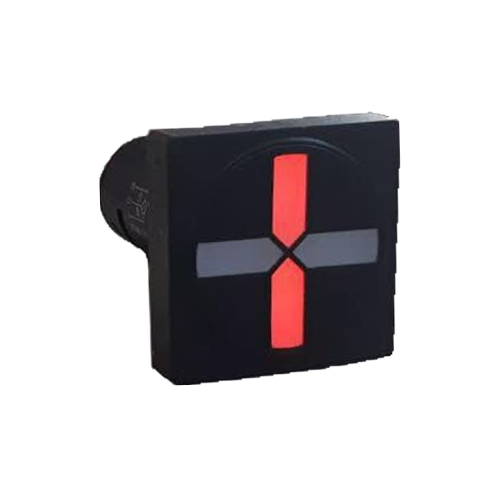
In the world of industrial automation and electrical panels, displaying equipment status for operators and engineers plays a vital role in the safe and efficient operation of a system. Two commonly used components for this purpose are the Pilot Signal Lamp and the LED Semaphore. Although both are used for visual notification, they have fundamental differences in function, application, and the type of information they convey. Understanding these differences is essential for correctly designing mimic diagrams and selecting the right component.
What is a Pilot Signal Lamp?
A pilot signal lamp, also known as a pilot light or indicator light, is the simplest type of status indicator. Its primary function is to signal a binary (on/off) condition or the presence/absence of a signal. In other words, a signal lamp has only two states: illuminated or off.
- **Type of Information:** This device conveys only a single bit of information: whether a specific condition exists or not. For example:
- Panel power is on
- A motor is running
- A general fault has occurred
- A valve is open
- **Type of Display:** Its display is monolithic and single-colored. A green light might signify a 'Normal' state, and a red light might mean 'Fault,' but each lamp is used independently for a separate signal.
- **Wiring:** The wiring for a signal lamp is very simple, typically requiring only two wires (Live and Neutral in AC systems or positive and negative in DC systems) to illuminate. These wires are supplied directly from a contact or a PLC/relay output.
What is an LED Semaphore?
A semaphore, often called a Position Indicator, is a more sophisticated display component designed to show the precise state or position of a multi-state device, such as a circuit breaker or disconnector.
- **Type of Information:** Instead of a single bit, a semaphore provides multiple bits of information within a single display unit. It can indicate several states, such as 'Open,' 'Closed,' 'Travel/Intermediate,' or 'Fault/Invalid.'
- **Type of Display:** Unlike a signal lamp, a semaphore typically uses a combination of two colors (often red and green) or graphical symbols to display the status. For example, in a standard semaphore for a circuit breaker:
- **Green symbol lit:** The breaker is in the Open position.
- **Red symbol lit:** The breaker is in the Closed position.
- **Both symbols off:** The breaker is in an intermediate position (traveling) or the semaphore's power supply is off.
- **Both symbols on or flashing:** An invalid state or a fault in the auxiliary contacts exists.
- **Wiring:** A semaphore's wiring is more complex than a signal lamp's. It requires at least three terminals: a common terminal and two input terminals for the 'Open' and 'Closed' signals. These signals are taken from the auxiliary contacts of the equipment itself (e.g., the breaker).
Comparison Table: LED Semaphore vs. Pilot Signal Lamp
| Feature | Pilot Signal Lamp | LED Semaphore Indicator |
|---|---|---|
| **Primary Purpose** | Indicate the presence or absence of a condition (binary) | Display the position or state of a multi-state device |
| **Information Type** | Single-bit (On/Off) | Multi-state (Open, Closed, Intermediate, Fault) |
| **Display Type** | Single-color, monolithic | Combination of colors or symbols (usually red & green) |
| **Common Application** | Power indicator, motor running, general fault | Breaker, disconnector, and earth switch status on mimic diagrams |
| **Signal Source** | One contact (NO or NC) | Two auxiliary contacts (one NO and one NC from the main device) |
| **Wiring Complexity** | Simple (usually 2 wires) | More complex (usually 3 or 4 wires) |
| **Safety & Interpretation** | Requires multiple lamps for multiple states | Provides complete, unambiguous information at a glance |
Which One to Choose?
The choice between a semaphore and a signal lamp depends entirely on the application:
- If you only need to know if a system is **on or off**, or if a **fault has occurred**, a **pilot signal lamp** is sufficient and cost-effective.
- However, if you need to know the **exact position** of a power switching device (e.g., on a substation's single-line diagram), using a **semaphore** is essential. A misinterpretation of a breaker's status can lead to catastrophic accidents, and the semaphore is designed specifically to prevent this ambiguity.
Rizmooj Electric Toos manufactures a wide range of high-quality LED semaphores for various applications in industrial electrical panels, substations, and power plants. Products like the CPS-501LE Square Semaphore are specifically designed to display four states for breakers: closed, open, intermediate, and invalid. These devices operate on a standard voltage of 110 VDC and, with their very low current consumption, are a reliable and optimal choice for installation on mimic diagrams. You can visit the Rizmooj Position Indicators (Semaphores) page to see all models.
Frequently Asked Questions
### Can I use two pilot lamps instead of one semaphore?
Theoretically, you could use a green lamp for 'Open' and a red lamp for 'Closed'. However, this approach has several key weaknesses: first, the 'intermediate' and 'fault' states (which a semaphore easily displays) cannot be distinguished. Second, it takes up more space and is visually more confusing for the operator. The semaphore is an industry standard for integrated and unambiguous status indication of switching devices.
### Why does a semaphore need auxiliary contacts?
A semaphore 'reads' and displays the actual state of the equipment. This reading is done via the auxiliary contacts of the breaker or disconnector. One contact acts when the equipment is 'Open,' and another acts when it is 'Closed,' sending the necessary signal to the semaphore. This mechanism ensures that the indicator is always synchronized with the actual state of the switchgear.
### What is the main difference between a Semaphore and a Position Indicator?
In practice, these two terms are often used interchangeably. 'Position Indicator' is a more general term that includes any device indicating the position of something. 'Semaphore' is a specific type of position indicator traditionally used to display the status of power system switchgear on mimic diagrams using red and green symbols.
Related Articles
- What is an LED Semaphore? A Complete Guide to Semaphore Indicators
- How to Wire an LED Semaphore
- How is a Semaphore Used in a Mimic Diagram?