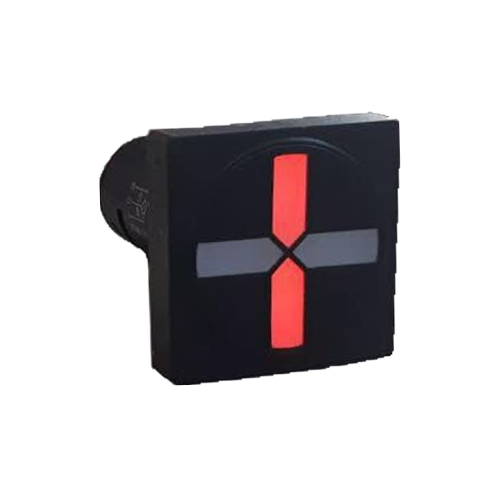
Semaphore Indicator vs. Stack Light
In industrial automation and control systems, displaying the status of equipment and processes is crucial for operators. Two common devices for this purpose are the Semaphore Indicator (or Position Indicator) and the Stack Light (or Signal Tower). Although both use light signals for communication, their application, design, and installation location are entirely different.
### Definition
- **Semaphore Indicator:** A small electrical or electromechanical indicator, typically mounted on the door of electrical panels, especially on mimic diagrams. Its primary function is to accurately display the status of a specific piece of equipment, such as a circuit breaker (closed/open) or a disconnector.
- **Stack Light:** A light tower composed of several colored modules (usually red, yellow, green, blue, and white) installed on industrial machinery, production lines, or in process areas. This device visually communicates the overall system status (e.g., normal, warning, fault) from a distance.
### Installation Type
- **Semaphore Indicator:** It is panel-mounted on the surface of the switchboard. These indicators usually have small dimensions (e.g., 22 mm or 35 mm diameter) to be easily placed within single-line diagrams (SLDs).
- **Stack Light:** It is surface-mounted vertically on the body of a machine or a pole to be visible from various angles and long distances.
### Viewing Distance
- **Semaphore Indicator:** Designed for close-range viewing (less than a few meters). The operator must be near the panel to discern the status of each semaphore.
- **Stack Light:** Designed for long-distance viewing (tens of meters). Its purpose is to quickly attract the attention of personnel in a large production hall or area.
### Application
- **Semaphore Indicator:** Its main application is in control and protection panels in electrical substations, power plants, and heavy industries. These indicators display the precise status of circuit breakers, disconnectors, and earth switches on a mimic diagram.
- **Stack Light:** Used in factories, assembly lines, and logistics systems to show the general status of a process. For example, green means normal operation, yellow means a need for raw materials, and red indicates a fault and line stoppage.
### Comparison Table
| Feature | Semaphore Indicator | Stack Light (Signal Tower) |
|---|---|---|
| **Primary Use** | Displaying equipment status in an electrical panel | Displaying the overall status of a machine or process |
| **Mounting Location** | On a panel's mimic diagram (panel mount) | On machinery body (surface mount) |
| **Viewing Distance** | Close (1-3 meters) | Far (up to 50 meters) |
| **Number of States** | Typically 2 to 4 states for one piece of equipment | Several general states (Normal, Warning, Fault) |
| **Audience** | Control room operator, maintenance technician | Production supervisor, floor personnel |
| **Example Use** | Showing a circuit breaker's open/closed status | Indicating a production line stop due to a technical fault |
What Do Red and Green Mean in a Semaphore?
The interpretation of colors in panel semaphores usually follows power industry standards, but project-specific contracts and documentation should always be consulted.
### Color Meanings
- **Red:** In general, the color red indicates a **Closed**, **energized**, or **in-service** state for a piece of equipment. This color alerts the operator that the circuit is live and potentially dangerous.
- **Green:** The color green typically signifies an **Open**, **tripped**, or **out-of-service** state. This condition is considered safer, but the absence of voltage must always be confirmed with testing instruments.
### Fault Status
A two-color (red and green) LED semaphore can also display additional states:
- **Both LEDs Off:** This usually means the semaphore's power supply is disconnected or there is a wiring issue. This is considered an 'unknown' state.
- **Both LEDs On:** In some designs, this state is used to indicate a 'transit' or 'fault' condition. For example, when a breaker is stuck between the open and closed positions.
### Relevant Standards
Standards like IEC 60073 address the allocation and meaning of colors and visual codes in Human-Machine Interfaces (HMIs). According to this standard, red is typically used for dangerous conditions or immediate action, and green for normal, safe conditions. However, in the electrical power industry, the 'Red = Closed' and 'Green = Open' convention is a widely accepted and common exception.
How is a Semaphore Used in a Mimic Diagram?
A mimic diagram is a schematic representation of a process or electrical system that is printed or engraved on the control panel.
- **Single Line Diagram:** The mimic diagram is usually a simplified version of the system's Single Line Diagram (SLD).
- **Equipment Representation:** A semaphore is installed at the location of each switching device (switchgear) such as a breaker, disconnector, or earth switch.
- **Linking Real Status to the Mimic:** The semaphore receives the equipment's actual status via its auxiliary contacts and displays it on the diagram. This allows the operator to understand the overall status of the substation or feeder at a glance.
LED Semaphore Selection Guide
Choosing the right semaphore requires considering several key parameters:
- **Supply Voltage:** Semaphores are available in various AC and DC voltages. In electrical substations, **110 VDC** is very common. Rizmooj products like the CPS-501LE are designed for these applications with a nominal voltage of 110 VDC and a high tolerance (±50%).
- **Display Type:** Determine how many states you need to display (two-state: open/close; three-state: open/close/fault; four-state: open/close/transit/unknown).
- **Dimensions and Shape:** Indicators are available in different shapes like round (e.g., Rizmooj's EPC-501LE) or square (e.g., EPS-501LE) to match the panel design and mimic diagram.
- **Installation Environment:** The Ingress Protection (IP) rating of the indicator must be compatible with the environmental conditions of the installation site (dust, moisture).
LED Semaphore Troubleshooting
If the semaphore is not working correctly, follow these steps:
| Symptom | Potential Cause | Solution |
|---|---|---|
| **Semaphore is completely off** | 1. Supply voltage is off (X0 terminal). <br> 2. Disconnected common wire. | 1. Check the voltage at the X0 terminal with a multimeter. <br> 2. Check the continuity of the common wire. |
| **Only one color (e.g., green) works** | 1. Failed red LED. <br> 2. Disconnected wire to the red status terminal (X1). <br> 3. Corresponding auxiliary contact is not working. | 1. Replace the semaphore. <br> 2. Check wire continuity from the auxiliary contact to terminal X1. <br> 3. Test the auxiliary contact's operation. |
| **Displays the wrong status** | The wiring for terminals X1 and X2 is swapped. | Swap the wires connected to the status input terminals (usually X1 and X2). |
What is a Position Indicator?
The term 'Position Indicator' is a more general name for devices that display the position or state of a machine. A Semaphore is a type of position indicator specifically used to show discrete states (like open/closed) on mimic diagrams.
Its main difference from a Signal Lamp is that a signal lamp typically indicates a single condition (like voltage presence or a fault) with one color, whereas a semaphore is designed to show two or more opposing states of one device (like open/closed).
Rizmoj Electric Toos products, such as the SPC-501LE and TPC-501LE models, are examples of LED position indicators used as semaphores in industrial and substation electrical panels.
Frequently Asked Questions
### Can a Stack Light be used instead of a semaphore in an electrical panel?
No. A Stack Light is designed for long-distance viewing and showing general status, and it has large dimensions. A semaphore is suitable for precise installation on a mimic diagram for close-range viewing and shows the detailed status of each piece of equipment.
### What is the main application of a semaphore?
Its main application is displaying the status of Circuit Breakers, Disconnectors, and Earth Switches on mimic diagrams in the control rooms of high-voltage substations and power plants.
### In a substation semaphore, why does red mean 'Closed'?
This is an industry convention to enhance safety. The color red draws the operator's attention to the fact that the circuit is 'energized' and 'dangerous,' and any maintenance work on it is prohibited. The color green indicates a 'safe' or de-energized condition.
Related Articles
- What is an LED Semaphore? A Complete Guide to Semaphore Indicators in Electrical Panels
- Semaphore LED vs. Signal Lamp: What's the Difference?
- How is a Semaphore Used in a Mimic Diagram?
- What Do Red and Green Mean in a Semaphore?
- LED Semaphore Selection Guide
---
To see our range of LED position indicators and semaphores, please visit our products page: