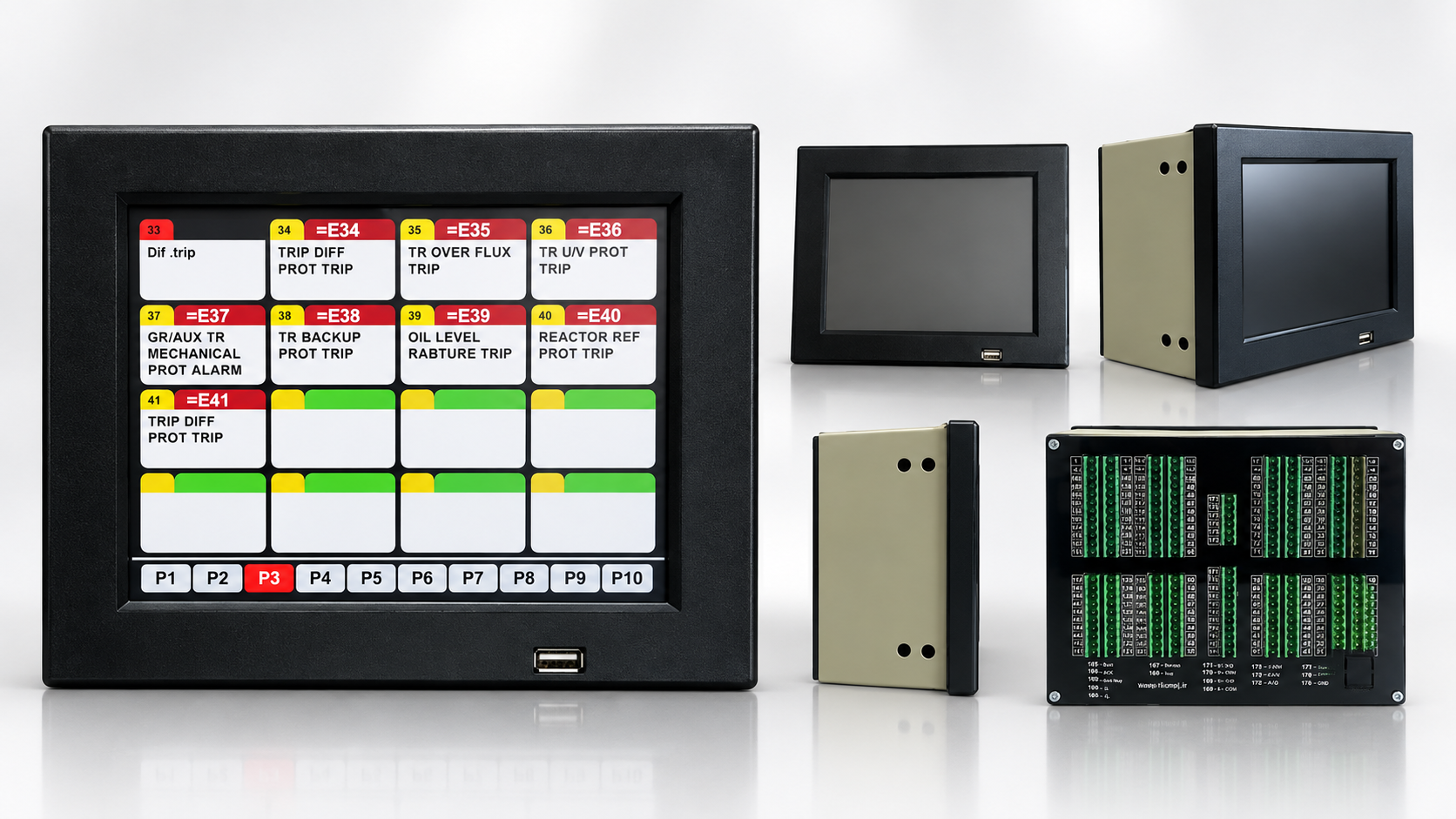
How Does an Alarm Window Work? A Complete Cycle
An Alarm Annunciator, or alarm window, is a device designed to draw an operator's attention to an abnormal condition (Fault) in an industrial process or power system. Its operation, from the moment a fault occurs until it returns to normal, follows a specific cycle known as an "Alarm Sequence." Below, we explore the main stages of this cycle.
### 1. Fault Detection
Everything begins with the occurrence of a "fault" or abnormal condition in the equipment. This fault could be a temperature rise, a pressure drop, a breaker opening, or the operation of a protective relay. This equipment typically activates a dry contact connected to the alarm annunciator's input.
### 2. Alarm Activation
Upon receiving the fault signal, the annunciator immediately activates the corresponding alarm. This activation manifests in both visual and audible forms.
### 3. Flashing Light
The window or indicator light corresponding to that specific fault begins to flash. The flashing state is designed to quickly attract the operator's attention and distinguish new alarms from previously acknowledged ones.
### 4. Audible Alarm (Horn/Buzzer)
Simultaneously with the flashing light, a horn or buzzer sounds. This audible signal ensures that the operator is notified of a new fault, even if they are not looking at the panel.
### 5. Acknowledge
Upon seeing and hearing the alarm, the operator must Acknowledge it. This is usually done by pressing the "ACK" button on the annunciator panel. Acknowledging the alarm has two effects:
- The horn is silenced (Silence).
- The flashing light turns into a steady light.
A steady light indicates to the operator and others that the fault has been seen and is being addressed, but has not yet been resolved.
### 6. Return to Normal
When the underlying problem in the equipment is fixed (e.g., the temperature returns to a normal level), the annunciator's input contact reverts to its initial state. At this stage, the alarm light (which was steady) turns off. In some alarm sequences, the light may not turn off and will wait for the Reset stage.
### 7. Reset
After the process returns to normal and the light goes out, the alarm logic may require a manual "Reset." Pressing the Reset button clears any internal memory of resolved alarms and prepares the system for future faults. In many systems, pressing Reset will have no effect if the fault is still present.
### 8. Lamp Test
Operators must be certain that all indicators and the horn are functioning correctly. The Lamp Test button simultaneously activates all alarm windows and the horn to identify any burnt-out bulbs or failures in the audio circuit. This test is typically performed at the beginning of each work shift.
What is a First Out Alarm and Why is it Important in Troubleshooting?
In complex industrial incidents, a single fault can trigger a cascade of subsequent faults. For example, the failure of a cooling pump (first fault) can lead to a reactor temperature increase (second fault), a pressure rise (third fault), and ultimately a complete system shutdown (Trip). In such situations, dozens of alarms activate simultaneously or in quick succession.
**First Out Alarm** is a feature in advanced alarm annunciators that identifies and distinctively displays the first fault in this chain (e.g., with a faster flashing rate). This feature helps the operator go directly to the root cause of the incident instead of chasing symptoms, drastically speeding up the troubleshooting process.
For more information, read the article "What is a First Out Alarm?"
What is a Sequence of Events (SOE)?
A **Sequence of Events (SOE)** recorder is a more advanced capability than a First Out Alarm. In systems equipped with SOE, every input status change (fault occurrence or clearance) is logged with a high-resolution timestamp, typically with an accuracy of one millisecond (1ms).
This functionality provides a complete, time-ordered report of all events before, during, and after an incident. By analyzing this report, engineers can gain a precise understanding of how protection systems operated, the exact timing of breaker trips, and the precise sequence of occurrences. SOE is a critical tool for post-mortem analysis of major incidents in power plants and transmission substations.
The article "What is a Sequence of Events or SOE?" explains this topic further.
The Difference Between Alarm, Warning, Fault, Event, and Trip
These terms are often used interchangeably, but they have distinct meanings in control engineering. Understanding their differences is essential for the proper management of industrial systems.
| Term | Definition | Industrial Example |
|---|---|---|
| **Event** | Any recordable change of state in the system. It can be a fault or a normal operation. | A switch opening, a pump changing state, receiving a command. |
| **Fault** | An abnormal condition or technical defect in a piece of equipment. | A short circuit in a motor winding, a broken pressure sensor. |
| **Warning** | An indication of a condition that is approaching a dangerous state but does not yet require immediate intervention. | Transformer oil temperature reaches 75°C (alarm threshold is 80°C). |
| **Alarm** | An indication of a dangerous or abnormal condition that requires immediate operator attention and action. | Transformer oil temperature reaches 85°C (trip threshold is 90°C). |
| **Trip** | An automatic protective action that results in stopping a process or disconnecting equipment to prevent damage. | A Buchholz relay operates and issues a trip command to the transformer's circuit breaker. |
For a more complete comparison, refer to the article "Difference Between Alarm, Warning, Fault, Event, and Trip".
Comparing an Alarm Annunciator to Other Systems
### Alarm Annunciator vs. SCADA
- **Location and Speed**: An annunciator is a local, hardware-based, and always-on system that displays alarms without delay. SCADA is a centralized software system that may require navigating through different screens to view alarms.
- **Reliability**: Due to their simple, hardware-based design, annunciators have extremely high reliability and are not affected by operating system or network issues. A SCADA system depends on a PC, network, and software.
- **Application**: An annunciator is designed for the immediate notification of critical alarms to a local operator. SCADA is used for comprehensive monitoring, control, and data analysis of an entire plant or power grid.
Read the article "Alarm Annunciator vs. SCADA" for more details.
### Alarm Annunciator vs. HMI
An HMI (Human-Machine Interface) is a graphical panel for interacting with a specific machine or process. While an HMI can display alarms, it is not a dedicated device for this purpose like an annunciator. Annunciators often provide a better, at-a-glance overview of the overall alarm status. More details are in "Alarm Annunciator vs. HMI".
### Alarm Annunciator vs. PLC
A PLC (Programmable Logic Controller) is an industrial controller that executes process logic. A PLC detects faults and can produce the necessary output to activate an annunciator, but it is not an alarm display device itself. In other words, the PLC is the brain of the operation, and the annunciator is its voice for signaling danger. More information is available in "Alarm Annunciator vs. PLC".
How to Connect a Protection Relay to an Alarm Annunciator
Protection relays (such as overcurrent, differential, or Buchholz relays) have output contacts. These contacts, which are usually Dry Contacts, are either normally open (NO) or normally closed (NC). To connect, one side of the relay contact is wired to the common input terminal of the annunciator, and the other side is connected to one of the alarm input channels. When the relay operates, the contact's state changes, and the annunciator detects it as a fault. For a visual guide, refer to the article "How to Connect a Protection Relay to an Alarm Annunciator".
Frequently Asked Questions
### Why are alarm annunciators still used when SCADA systems exist?
Because of their extremely high reliability, simplicity, and immediate access. An alarm annunciator is not dependent on software issues, computer freezes, or network outages, and it acts as a critical, independent layer of safety. For more information, read the article "Can SCADA Replace an Alarm Annunciator?".
### What is the most important feature when selecting an alarm annunciator?
Different features are important depending on the application. For critical applications, reliability, response speed, and display clarity are paramount. For incident analysis, features like First Out Alarm and SOE with high time accuracy (1ms) become crucial.
### What is the main difference between Acknowledge and Reset?
Acknowledge means confirming and attending to an active alarm (it silences the horn and makes the light steady). Reset is used to clear the memory of alarms whose fault conditions have been resolved and have returned to normal.
Related Products by Rizmoj Electric Toos
Rizmoj Electric Toos manufactures a wide range of alarm annunciators for various industrial and substation applications.
- **AMA500 Series**: This advanced model, featuring a color touch screen, high input capacity (up to 160 channels), and Sequence of Events (SOE) recording with 1ms accuracy, is ideal for power plants, transmission substations, and large industries that require precise incident analysis. This device supports MODBUS and IEC60870-5-101 communication protocols.
- **AMA-535**: A classic 35-window alarm annunciator designed for quick and centralized display of alarm statuses on control panels, offering a reliable and cost-effective solution.
To view all models and choose the product that fits your needs, please visit the Alarm Annunciators page.
Related Articles
- What is an Alarm Annunciator? A Complete Guide to Industrial Alarm Windows